2026
Drawing lines: Racial and partisan gerrymandering in a divided America
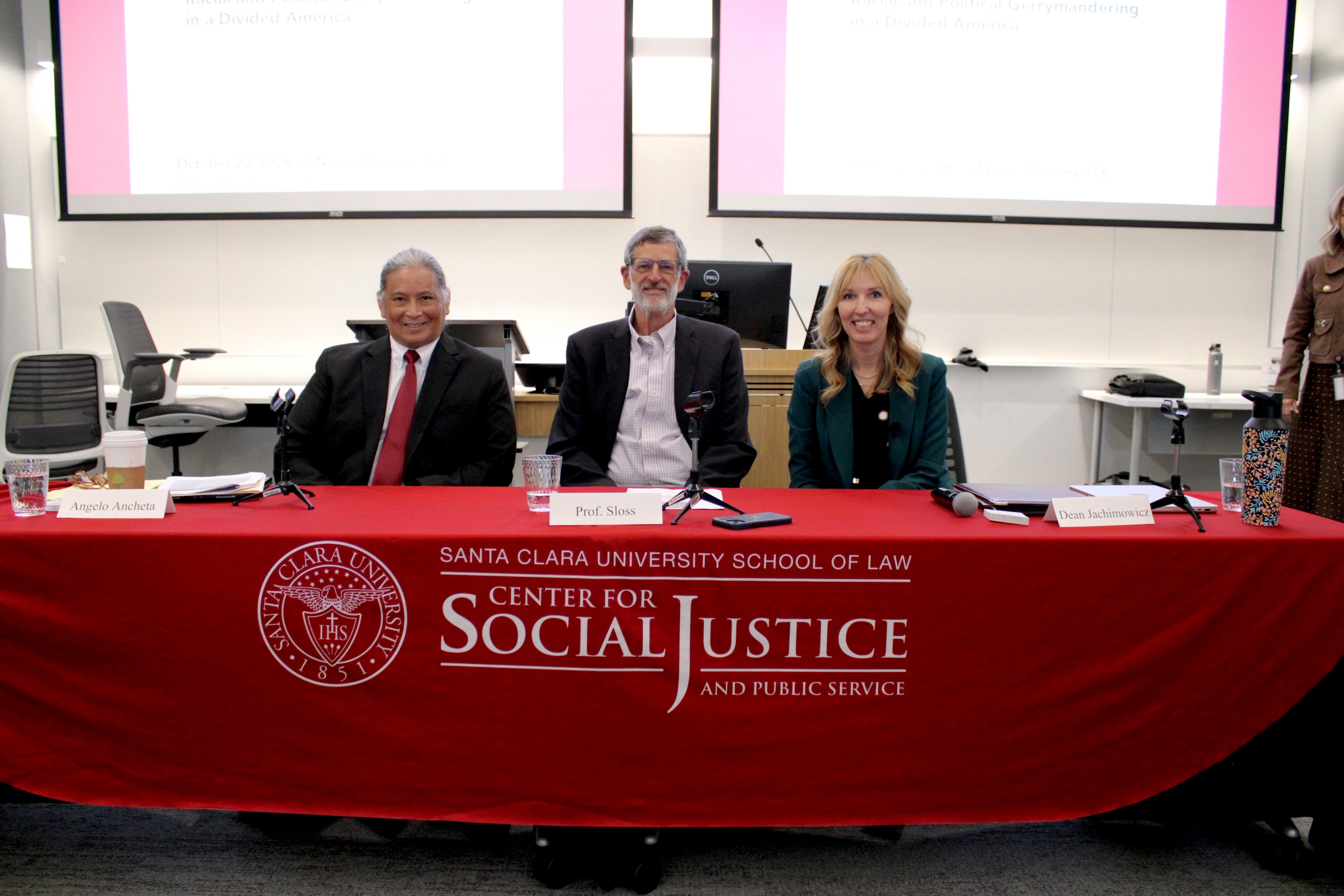
As part of the ongoing Dean’s Democracy Series, Santa Clara Law hosted a panel unpacking how a series of Supreme Court cases have effectively paved the way for racial and partisan gerrymandering in the United States. The panel featured lawyer, political scientist, and former KGACLC Executive Director Angelo Ancheta, Professor David Sloss, and Associate Dean Caitlin Jachimowicz.
Race and voting in the United States
Ancheta began the discussion with a brief overview of the relationship between race and voting rights in the U.S. The landmark Voting Rights Act of 1965 (VRA) is largely predicated on the 15th Amendment, which states: “The right of citizens of the United States to vote shall not be denied or abridged by the United States or by any State on account of race, color, or previous condition of servitude.”
The seminal 1986 case, Thornburg v. Gingles, established that plaintiffs do not need to prove intentional discrimination to win a claim under the VRA. This decision addressed the issue of “vote dilution” or the reduced effectiveness of one’s vote through means such as gerrymandering, explained Ancheta. The outcome created a broad test that acknowledged the reality that many legislative districts in America continue to be residentially segregated by race.
However, the VRA has continuously been undercut since the 1990s. Notably, the 2026 case Louisiana v. Callais effectively declared that plaintiffs must prove intentional discrimination to win a vote dilution claim under the VRA, and it allowed state legislatures to pursue partisan advantage in the context of redistricting. “What we’re seeing now is an environment where the court, in particular the SCOTUS, has tried to wipe out racial consideration,” said Ancheta.

Drawing for advantage
Sloss followed Ancheta’s remarks with a closer look at partisan gerrymandering. He explained that there are four types of gerrymandering: incumbent protection, malproportionment, racial, and partisan. Incumbent protection gerrymandering, as the term denotes, is redistricting with the goal of securing wins for the candidate currently in power. Malproportionment came to a head in the 20th Century, when large populations moved from rural areas to urban areas, but district lines were kept the same. It was declared unconstitutional by the SCOTUS in a pair of 1964 cases. Racial gerrymandering draws districts to dilute voting power from concentrations of racial minorities. Partisan gerrymandering establishes districts to favor one party over the other.
The 1986 case, Davis v. Bandemer, was the first case to address partisan gerrymandering. Six justices agreed that it was unconstitutional, but they couldn’t get a majority to agree on the standard for determining what counts as partisan gerrymandering, Sloss explained. Subsequent cases argued about whether federal courts should be adjudicating the issue at all. In Rucho v. Common Cause (2019), the Supreme Court decided that partisan gerrymandering claims are non-justiciable, meaning that federal courts lack the power to decide such claims. Then, in Callais (2026), the Court effectively cleared the way for states to engage in racial vote dilution under the guise of partisan gerrymandering.

The Fallout
Jachimowicz closed out the panel discussion by detailing how the political landscape has changed as a result of the SCOTUS rulings. While redistricting traditionally takes place every decade, the timeline has been halved through “mid-decade redistricting wars.” Even areas that have made efforts to curtail partisanship through non-partisan or bipartisan commissions see their work being quickly erased.
Jachimowicz presented a timeline of events starting from July 2025 to illustrate this pace of change.
- July 2025 - November 2025: President Donald J. Trump calls on the GOP to redraw state congressional maps outside of the standard post-Census cycle. Multiple states take immediate action and pick up extra Republican seats.
- November 2025 - June 2026: Both Democrat and Republican-controlled states respond through referenda and propositions.
- SCOTUS gets involved through a series of decisions on newly-drawn maps and procedural requirements.
The SCOTUS rulings have largely favored Republicans, but reliance on 2024 voting data to draw maps may lessen the impact of the partisan gerrymandering. However, the “redistricting wars” are far from over. Ancheta predicted that 2030 would come with changes at every single level of government. After all, he said, those in power want to keep power and those not in power want to get power.
Angelo Archeta, David Sloss, and Caitlin Jachimowicz