2026
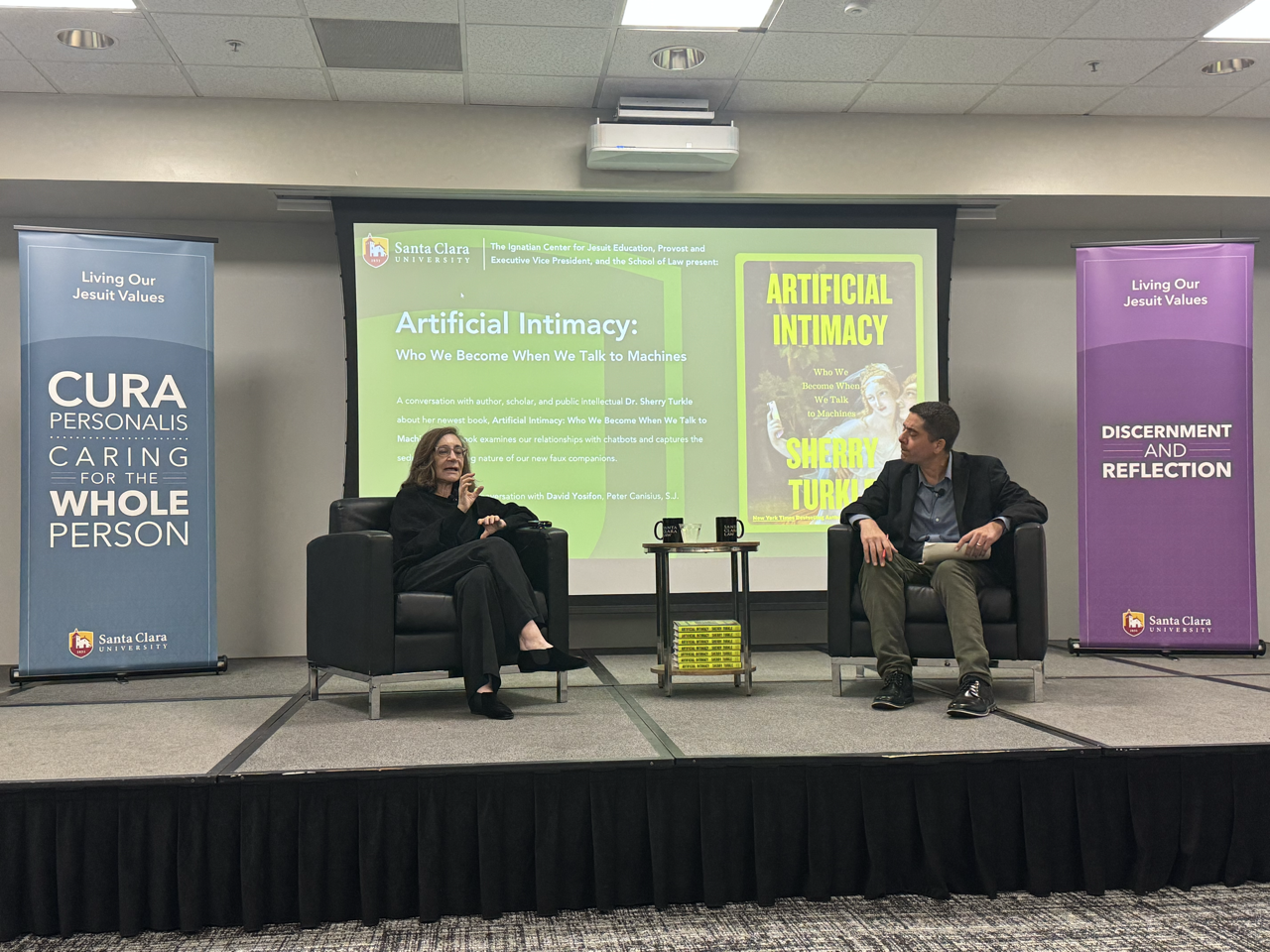
Can a chatbot replace human connection? MIT Professor Sherry Turkle explores the risks of artificial intimacy
Can AI be your best friend? Can avatars replace grandparents who have passed away?
As artificial intelligence becomes more personal, these questions are no longer hypothetical. People are turning to chatbots for companionship, comfort, and support. But what happens when the ease of talking to a machine makes human relationships feel less appealing?
On Oct. 23, Dr. Sherry Turkle, author, public intellectual, and professor at the Massachusetts Institute of Technology (MIT), brought these questions to Santa Clara University. In a conversation with School of Law Professor David Yosifon, Turkle explored the risks of AI companionship, drawing on her latest book, Artificial Intimacy: Who We Become When We Talk to Machines.
Her central warning was simple: We must be careful not to “substitute the fake for the real in everyday life.”
The appeal of artificial intimacy
Dr. Turkle, the Abby Rockefeller Mauzé Professor of the Social Studies of Science and Technology at MIT, has spent decades studying how technology shapes human relationships. Her work examines not just what technology can do, but also how it changes the way people understand themselves and connect with others.
In her new book, she talks about why chatbots are so appealing. They listen without interruption, respond to your complaints with constant validation, and adapt to what you want to hear. They simulate empathy without any of the friction we deal with in human relationships.
Rebuilding the spaces that bring us together
Dr. Turkle also linked the rise of AI companionship to a broader problem: loneliness.
She pointed to the growing market for technologies that promise connection in a society where people have fewer opportunities to interact organically. She argued that the answer to loneliness cannot rest solely on creating more sophisticated machines. Rather, it means rebuilding the social spaces that make human connection possible.
Dr. Turkle described how her grandmother, who had little money but a rich network of social relationships, would meet all her friends in shared physical spaces such as libraries and parks.
Even when people recognize that relationships with chatbots are artificial, the convenience and comfort can make them seem like a reasonable substitute. The question, then, is not simply whether AI can imitate authentic connections. It is whether there is too much in the way of forming those connections in our modern world.
The figures are startling. Dr. Turkle brought up a few data points: “Young children are so lonely that half of all sixth graders already have an AI best friend. Seventy-five percent of teenagers now have an AI chatbot.”
When technology enters our most vulnerable moments
The stakes become especially personal when AI attempts to stand in for loved ones who have passed away.
Dr. Turkle shared her experience with an AI-generated avatar designed to allow her descendants to learn about the kind of person she was. Instead, the avatar spread misinformation and portrayed her in ways she found troubling.
Such incidents raise pertinent questions about how tech companies should protect vulnerable users and what boundaries may be needed.
Throughout the conversation, Professor Yosifon's questions pushed the discussion beyond a simple warning about technology. If someone feels their loneliness is inescapable, is it necessarily wrong to let a chatbot provide comfort? And how should society weigh that comfort against the risks of replacing human relationships?
There are no easy answers. But the questions point to the need for thoughtful discussion about the role AI should play in people's lives. “My position isn’t anti-technology,” Turkle said. “It’s a pro-human book.”
Her message was not that people must reject AI altogether. Rather, it was a call to consider what people might lose when AI sells a relationship without the demands of a real one.
The event was the fifth installment of the Compelling Conversations series, organized in collaboration with the Provost's Office, the School of Law, and the Ignatian Center for Jesuit Education. Provost James Glaser delivered opening and closing remarks.
Dr. Sherry Turkle and Professor David Yosifon