2026
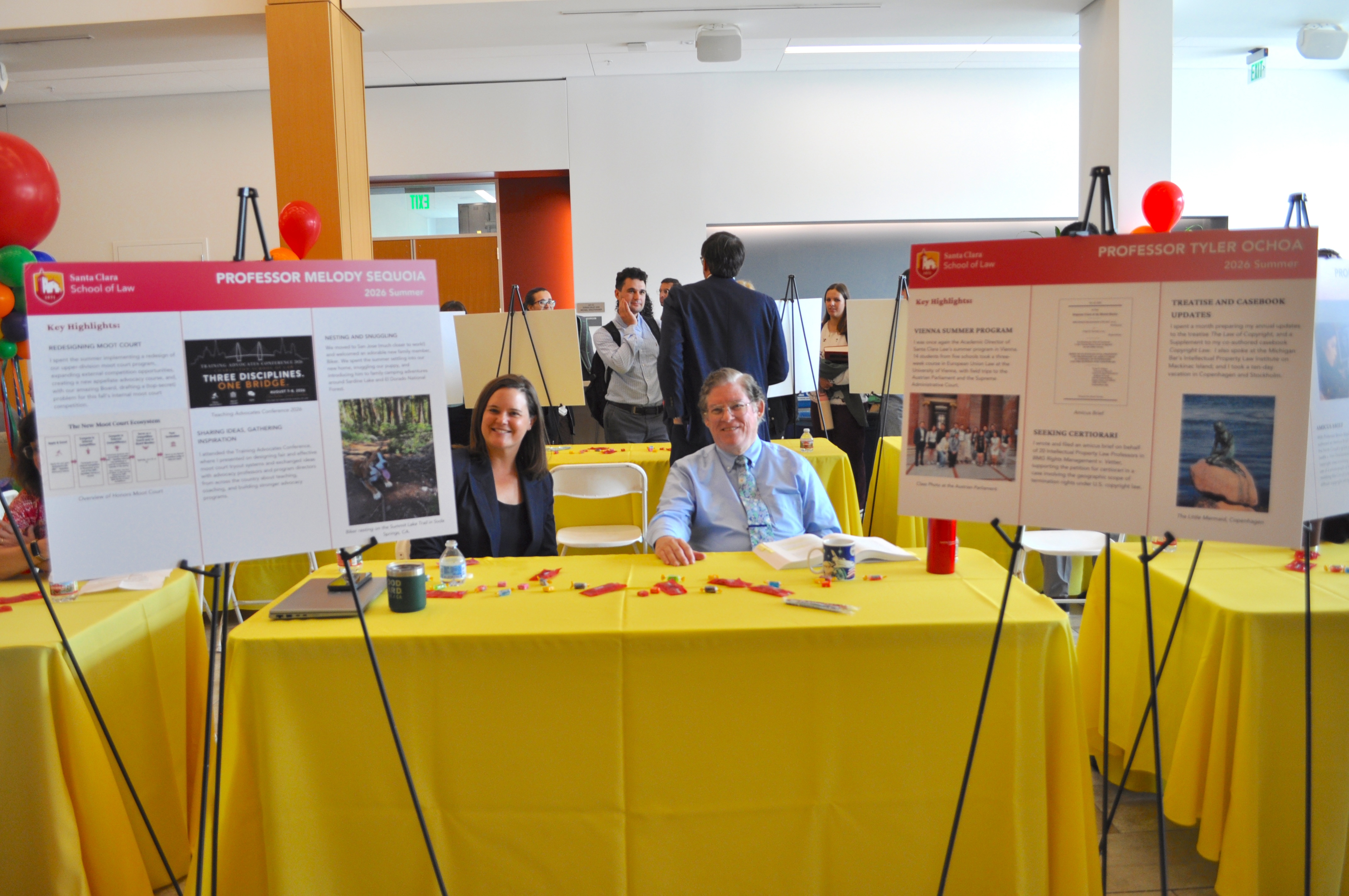
"What I Did This Summer" event brings faculty work into view
Summer break can feel like a black box: final exams end, the halls clear, and the academic pressure briefly fades. But while school is out of session, professors go out of office and into the field, working on projects that often go unseen.
To bridge that gap, Professor and Associate Dean of Research Eric Goldman and the Faculty Enrichment Committee launched the What I Did This Summer event in 2025. It was modeled after an academic poster symposium but designed with a broader purpose: to provide a window into the work everyone does beyond the classroom.
Twenty faculty and staff participated in this year’s event, held in the Charney Hall Atrium. The posters, created with support from the Advancement, Alumni Relations, & Communications team, displayed their summer activities at a glance. The event drew a strong turnout, with students making up much of the crowd.
Why visibility matters
Faculty spent their summer doing a little bit of everything—and going nearly everywhere.
Most featured newly published casebooks, articles, and briefs, as well as a number of books still in progress. Others shared snapshots of international travel, from vacations in Greece and Copenhagen to presentations and study-abroad programs across Europe. Some talked about personal highlights, including time well-spent with family and moving to California.
As Goldman emphasized, “Our faculty and staff are constantly doing interesting things, especially during summer, but those activities and achievements often aren't well-known in the community. Making these under-publicized activities and achievements more visible celebrates the work, increases the possibility of finding points of connection within the community, and helps further disseminate any research findings.”
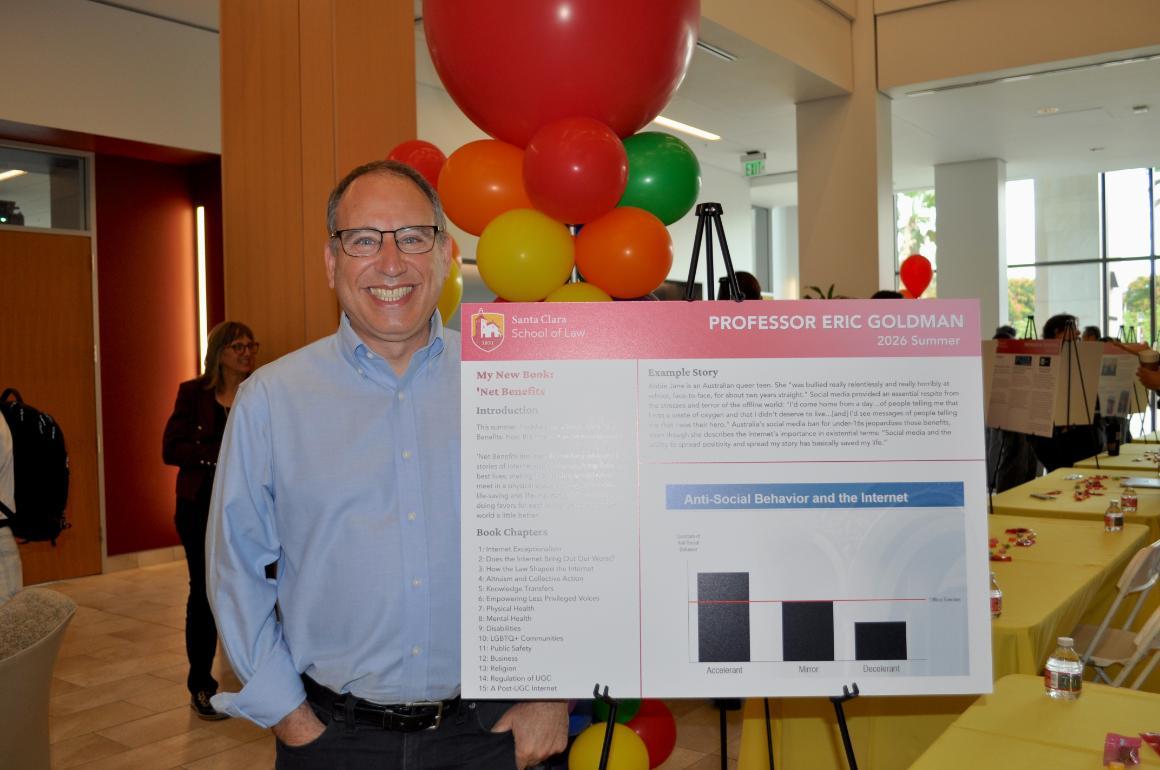 Professor and Associate Dean of Research Eric Goldman
In its second year, What I Did This Summer is a new tradition for kicking off the school year. Goldman hopes it will become “an even more critical part of our social fabric” and continue bringing people closer together.
Students described the posters as eye-catching and informative. For 1L student May Dashiell, attending the event helped her make connections she wouldn’t otherwise have: “I wanted to talk to Professor Oberman about her research about abortion and also the birth rate issue. Because she’s not my professor, I was a little nervous to talk to her, but she was really willing to share what she’s researching and to offer future communication about the issue if I wanted to talk to her later, which was good to find out.” This curiosity echoed across the Atrium, where other posters sparked equally thoughtful conversations.
Professor Sean Bland on sexual health justice
Over the summer, Professor Sean Bland presented his research on sexual health justice, including a law review article proposing a “sexual thriving” policy framework. He also wrote an article titled “Surviving Well: A Health Justice Approach to Sex Work,” which examines how legal approaches to sex work can better address the root causes of health inequities while promoting autonomy and reducing criminalization. His summer also brought a national honor: the National LGBTQ+ Bar Association named Bland one of its Best LGBTQ+ Lawyers Under 40 in 2026.
“It is exciting to talk with students about how my research in public health law is related to criminal law, racial justice, gender justice, LGBTQ rights, labor rights, and other issues,” Bland said. He also noted that students were particularly interested in his involvement with the National LGBTQ+ Bar Association and how he seeks to “effect change by making connections between academic research and legal practice.”
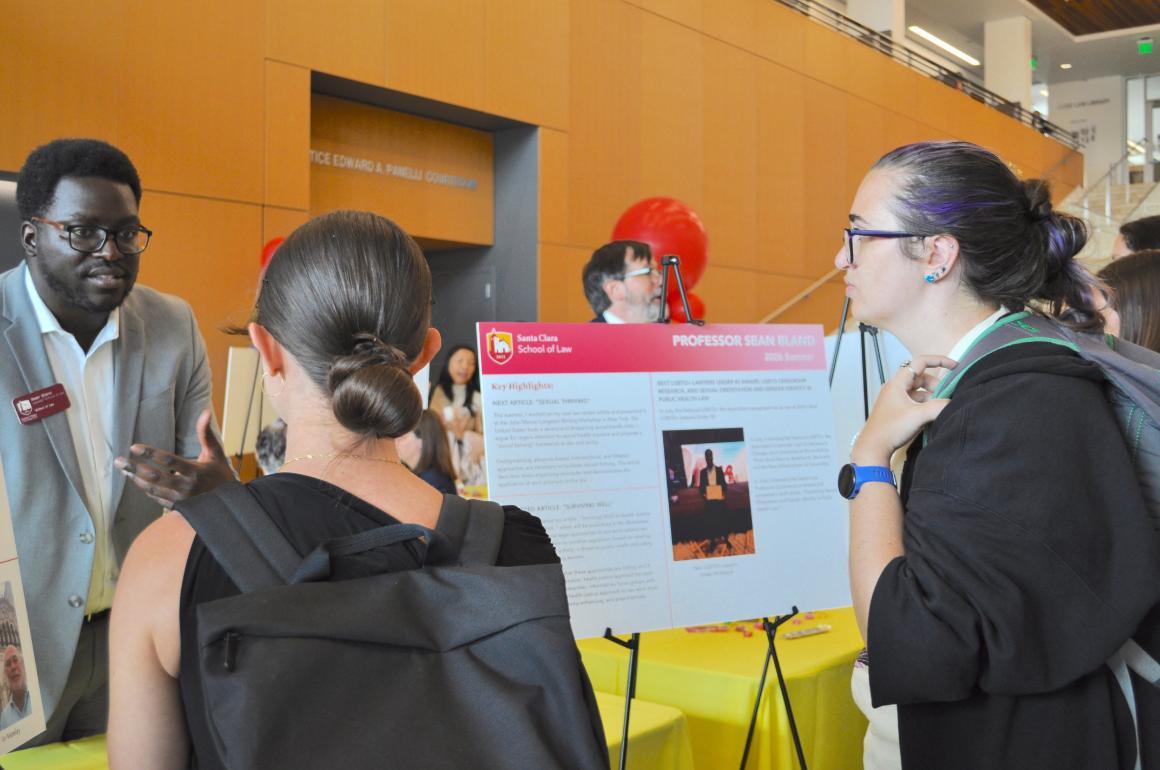 Professor Sean Bland shares his summer research with students
Professor Catherine Sandoval on digital discrimination
At the event, Professor Catherine Sandoval shared her Ph.D. thesis on the socio-legal construction of the digital divide and digital discrimination in Los Angeles County. She traced how historic redlining and later regulatory decisions have contributed to unequal access to affordable internet in low-income communities.
The topic quickly drew dozens of students to her poster, where they questioned why residents in low-income areas are expected to pay more for gigabit-speed internet than those in wealthier neighborhoods. “Law students understand how critical the internet is to education, job opportunities, and access to resources including health services,” Sandoval said, noting that their exchanges also prompted a discussion about whether existing state laws could address these practices or whether reform is needed. For Sandoval, the event gave students a chance to apply what they are learning in class to a real-world issue.
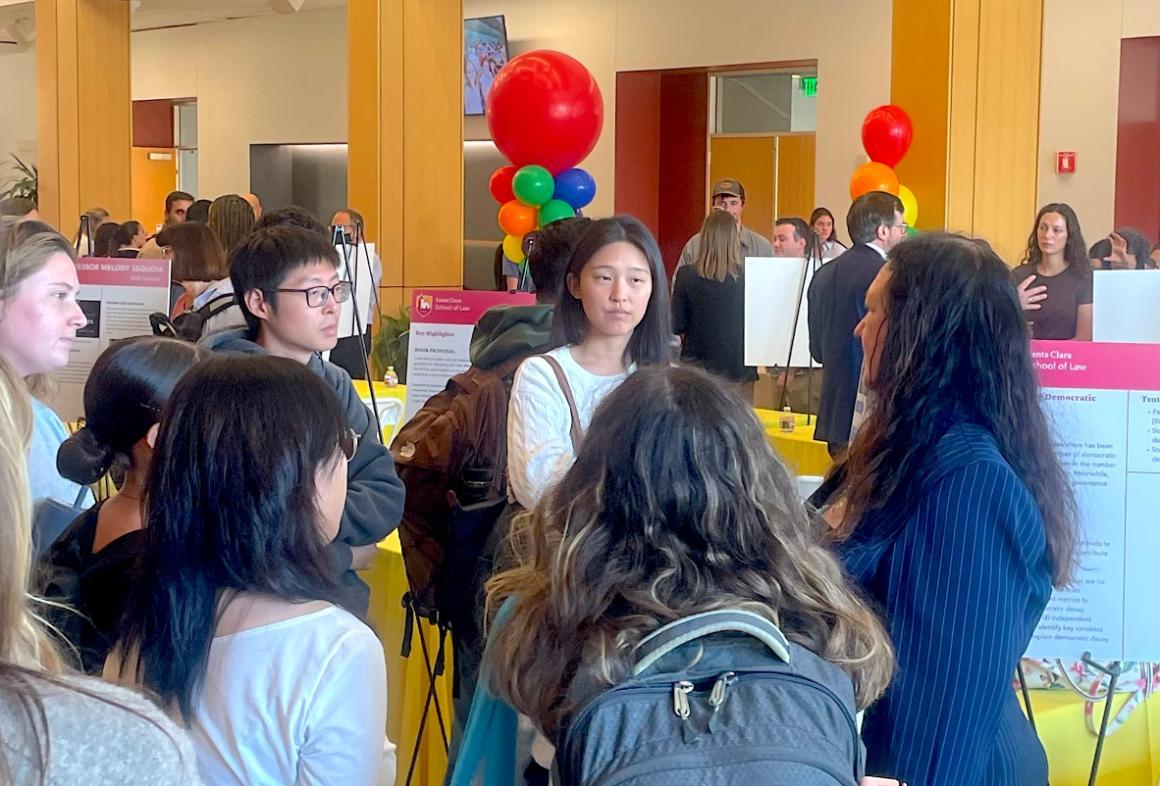 Students gather around Professor Catherine Sandoval to learn more about her research
Professor Sandee Magliozzi’s holistic approach to lawyering
For Professor Sandee Magliozzi, the event publicly introduced the Relational Lawyering course in development. Drawing on her background in competencies and lawyering skills, the course takes a holistic approach to working through client issues. She explained, “It’s really about thinking whole-person [or] broader ways of solving legal problems” and teaching future lawyers to understand who the client is, what matters to them, and how they can best be supported.
The focus on relationships tied into Magliozzi’s experience at the event. She appreciated getting to see what her colleagues are working on and to observe which topics captured students’ attention. “It creates that relational community that we have,” she said. “And it’s really fun to see what different things students respond to. Some things they have familiarity with, some things they don’t, [and] they’re curious, so [it’s] always fun to see what strikes them.”
At the event, each poster achieved its purpose of bringing faculty work into the open, but also invited connection among like-minded peers. Making that work visible sends a clear message to the Santa Clara Law community: Curiosity, questions, and shared interests have a home here.
Professors Melody Sequoia and Tyler Ochoa