Upper Division Honors Moot Court
Honors Moot Court is Santa Clara Law’s advanced advocacy program for students who want to develop high-level legal writing and oral argument skills. Students research complex issues, write appellate briefs, and present oral arguments in teams before panels of judges, just like real-world appellate lawyers. Participating in a competitive moot court competition has unique benefits in ways that a traditional classroom or clinic cannot fully replicate. Students face real-world pressure when they argue under time limits, face live questioning from multiple judges, and compete against other teams. Students participate in multiple rounds that give them the chance to refine their arguments, learn from feedback, and adjust their strategy. Most moot court competitions require students to argue both sides of a case (“on brief” and “off brief”), forcing them to develop a deep understanding of the issues. Students also work closely in teams, which develops students’ collective problem-solving skills in ways that mirror real-world practice (and not just private litigation practice or appellate practice).
Starting in the 2026-2027 academic year, Santa Clara will combine its two separate upper-division moot court programs (formerly HMCI and HMCE) into one unified Honors Moot Court (HMC) program. The new design provides the structure, coaching, and mentorship students need to progressively build these skills by offering a supportive environment where advocates can practice, receive feedback, and grow in confidence and competence.
The biggest change? There is now a dedicated fall course – Honors Moot Court: Appellate Advocacy – which culminates in what used to be the HMCI Moot Court Competition. That internal competition (which will take place in the fall, not the spring) will serve as the training ground for spring appellate competitions around the country. The Honors Moot Court: Appellate Advocacy course is taken in lieu of Advocacy. This creates a clearer path, more faculty instruction, and stronger preparation before students compete nationally at external competitions.
While the new Honors Moot Court: Appellate Advocacy course will be required for appellate-level moot court competitions (i.e. one that simulates an appellate court case, usually a Supreme Court case, and involves brief writing and competitive, multi-round oral arguments), a number of non-appellate focused moot court competitions will be open to any interested student regardless of whether they complete the Honors Moot Court course, so long as that student completes Advocacy and has related coursework or experience suitable for those competitions. Non-appellate competitions include, but are not limited to, mediation, client counseling, and negotiation competitions, certain international law competitions, patent drafting competitions, and sports infraction hearing competitions.
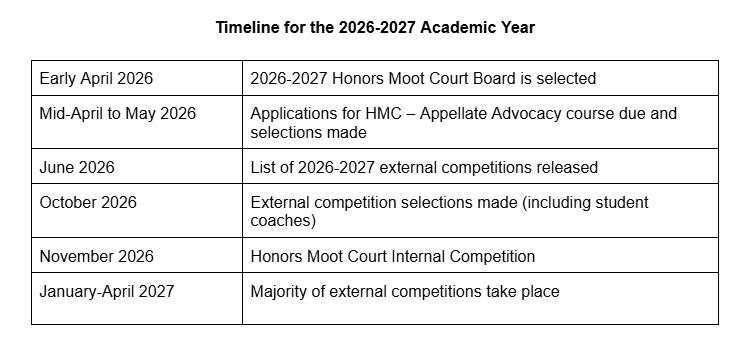
Student Coaches. Senior members (typically 3L or 4L students) with prior competition experience, are encouraged to take an active leadership role by serving as competition coaches and mentors. Coaches for external competitions are typically selected in October of each year, and they may earn up to one academic credit for their work in the following Spring semester.
Board Members. In addition to serving as a competition Coach, senior members may apply to become a Board Member. Board Members play a critical leadership role in administering the program, supporting competitors, and ensuring the quality and professionalism of both the internal competition and external competition placements. Board members work closely with the Director, law school faculty, and attorneys to manage program operations, recruit judges, mentor students, and uphold competition standards. Board service is a significant year-long commitment and is intended for students who are organized, reliable, and invested in the success of the program as a whole. Anticipated Board positions for the 2026-2027 academic year include: President, VP Judicial Recruitment, VP of Operations, VP of Public Relations, Problem Committee, and Curriculum Committee. Board members for the 2026-2027 academic year will be selected at the end of the Spring 2026 semester (likely in April).
For more information on the Honors Moot Court Program for the 2026-2027 academic year, including program entry requirements, see the HMC Handbook.
Are you currently a 1L interested in Honors Moot Court in the 2026-2027 academic year?
During the Spring semester of your 1L year (typically in April), you will need to apply for entry into the HMC - Appellate Advocacy Course for the following fall semester (Fall 2026). The HMC – Appellate Advocacy Course is a 3-unit course, which may be taken in lieu of Advocacy (LAW 105). HMC – Appellate Advocacy covers the same substantive content as Advocacy, but with an added component of a competitive internal moot court competition at the end of the Fall semester, typically between weeks 13 and 15. Students interested in external appellate moot court competitions after completing HMC – Appellate Advocacy will be assigned to an external competition based on interest, availability, financial considerations, and performance in the internal competition. No new application is required for participation in an external competition.
There will be two information sessions leading up to the application deadline. Exact date/location TBA.
Are you currently an upper-division student interested in external moot court competitions in the 2026-2027 academic year?
For the 2026-2027 academic year only, 3L students – i.e., students who took first-year legal writing (LARAW I and II) in the 2024-2025 academic year – are not required to take HMC – Appellate Advocacy in order to be eligible for external competitions. These 3L students may apply for any external competition, provided that they have taken Advocacy (LAW 105). An external competition list for the 2026-2027 academic year will be released by June of 2026. External competition selections will be made by October of 2026, possibly earlier depending on the competition. Most, but not all, external competitions take place in the Spring semester, but for some competitions, some work will be required over winter break.
What if a student is not selected for HMC - Appellate Advocacy (or is somehow unable to take HMC - Appellate Advocacy in Fall 2026) but wants to participate in moot court?
You may still apply directly to some non-appellate or certain specialized competitions. A list of anticipated competitions for the 2026-2027 academic year will be released by June of 2026. External competition selections will be made by October of 2026, possibly earlier depending on the competition. Most, but not all, external competitions take place in the Spring semester, but for some competitions, some work will be required over winter break.
Do you have prior moot court experience and are you interested in serving as a competition coach or board member in 2026-2027?
We need you! For roles and responsibilities of student coaches and board members, see the HMC Handbook sections VI and VII. Please be on the lookout for information on Board applications around April 2026. Student coaches will likely be selected in the beginning of the Fall 2026 semester. You may also contact Professor Sequoia directly at msequoia@scu.edu to discuss further.